
4G vs LoRaWAN vs LoRa vs NB-IoT for Remote Level Monitoring
Table of Contents
- What Is Remote Level Monitoring?
- How Does a Wireless Level Monitoring System Work?
- Overview of 4G, NB-IoT, LoRa, and LoRaWAN
- 4G vs NB-IoT vs LoRaWAN vs LoRa Comparison
- Which Wireless Technology Should you Choose?
- Wireless Level Monitoring Solutions for Different Applications
- HOLYKELL Wireless Level Monitoring Solutions
- Frequently Asked Questions
- About the Author
Introduction
Many water tanks, reservoirs, fuel tanks, and industrial vessels are installed in remote areas where wired connections are difficult, expensive, or impractical.
Traditional level monitoring systems often require long-distance cables, complex installation, and high maintenance costs. Wireless level monitoring provides a smarter solution by allowing users to remotely monitor liquid levels, receive alarms, and manage assets through cloud platforms.
However, choosing the right wireless communication technology is critical. Different technologies, including 4G, NB-IoT, LoRa, and LoRaWAN, have different advantages.
What Is Remote Level Monitoring?
Remote level monitoring is a system that allows users to measure and view liquid levels from a remote location without manually checking the tank or vessel.
It is widely used for:
- Water tanks
- Reservoirs
- Wells
- Irrigation systems
- Fuel storage tanks
- Wastewater tanks
- Industrial process tanks
A typical remote level monitoring system includes:
Level Sensor
The sensor measures liquid level through different technologies, such as:
- Hydrostatic pressure measurement
- Radar measurement
- Ultrasonic measurement
Wireless Communication Module
The measured data is transmitted through:
- 4G
- NB-IoT
- LoRa
- LoRaWAN
Cloud Platform
Then the data is uploaded to a monitoring platform for remote management.
How Does a Wireless Level Monitoring System Work?
A typical wireless level monitoring process.
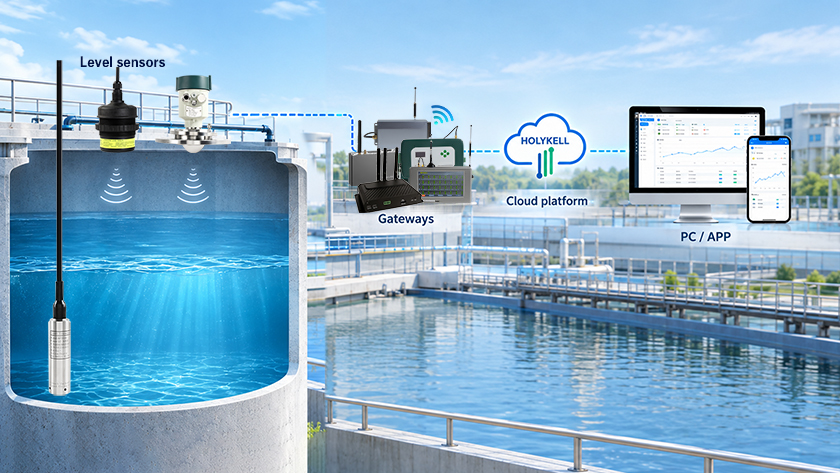
For example:
A submersible level sensor installed in a water tank continuously measures the water level.
The sensor sends the data through a wireless network. The cloud platform receives and analyzes the data. Users can check the tank level remotely and receive alarms when the level is too high or too low.
Overview of 4G, NB-IoT, LoRa, and LoRaWAN
1. What Is 4G for Remote Level Monitoring?
4G is a cellular communication technology widely used for high-speed wireless data transmission. A 4G level monitoring system usually uses a level sensor, 4G communication module, and a Cloud platform.
Advantages of 4G
- ✔ Wide network coverage
- ✔ High data transmission speed
- ✔ Real-time monitoring capability
- ✔ No additional gateway required
- ✔ Suitable for video, images, and large data transmission
Limitations of 4G
- ✘ Higher power consumption
- ✘ Requires SIM card
- ✘ Battery-powered applications may require larger batteries
Typical Applications
4G is commonly used for:
- Industrial water tanks
- Fuel monitoring systems
- Remote pumping stations
- Real-time equipment monitoring
2. What Is NB-IoT for Remote Level Monitoring?
NB-IoT (Narrowband Internet of Things) is a cellular IoT technology designed specifically for low-power, wide-area applications. Compared with 4G, NB-IoT focuses on:
- Low power consumption
- Long battery life
- Small data transmission
Advantages of NB-IoT
- ✔ Very low power consumption
- ✔ Long communication range
- ✔ Excellent indoor penetration
- ✔ Suitable for battery-powered devices
- ✔ Uses existing cellular networks
Limitations of NB-IoT
- ✘ Lower data transmission speed
- ✘ Not suitable for high-frequency data transmission
Typical Applications
NB-IoT is suitable for:
- Remote water tanks
- Smart water meters
- Underground tanks
- Agricultural irrigation monitoring
- Environmental monitoring
3. What Is LoRa for Remote Level Monitoring?
LoRa (Long Range) is a wireless communication technology designed for long-distance, low-power communication. LoRa is mainly used for private wireless networks. A typical LoRa system includes:
- LoRa sensor
- LoRa gateway
- Monitoring platform
Advantages of LoRa
- ✔ Long communication distance
- ✔ Very low power consumption
- ✔ Suitable for remote areas
- ✔ No cellular subscription cost
Limitations of LoRa
- ✘ Requires a gateway
- ✘ Communication range depends on environment
Typical Applications
LoRa is often used in:
- Farms
- Factories
- Water plants
- Large industrial sites
4. What Is LoRaWAN for Remote Level Monitoring?
LoRaWAN is a communication protocol based on LoRa technology. It defines how LoRa devices communicate with gateways and network servers. A LoRaWAN system usually includes:
- LoRaWAN level sensor
- LoRaWAN gateway
- Network server
- Cloud platform
Advantages of LoRaWAN
- ✔ Supports thousands of IoT devices
- ✔ Low power consumption
- ✔ Long-range communication
- ✔ Suitable for large sensor networks
Limitations of LoRaWAN
- ✘ Requires gateway deployment
- ✘ Lower data transmission speed
Typical Applications
LoRaWAN is suitable for:
- Smart water management
- Multiple tank monitoring
- Smart agriculture
- City-level IoT applications
4G vs NB-IoT vs LoRaWAN vs LoRa Comparison
Choosing the right wireless technology depends on the specific requirements of the level monitoring project, including communication distance, power supply, data frequency, installation environment, and network availability.
The following table provides a quick comparison of the four wireless technologies.
| Feature | 4G | NB-IoT | LoRaWAN | LoRa |
|---|---|---|---|---|
| Network Type | Cellular network | Cellular IoT network | LPWAN protocol | Wireless communication technology |
| Communication Mode | Cellular | Cellular | Private or public IoT network | Private wireless network |
| Gateway Required | No | No | Yes | Yes |
| SIM Card Required | Yes | Yes | No | No |
| Communication Range | Wide coverage | Wide coverage | Long range | Long range |
| Power Consumption | High | Very Low | Very Low | Very Low |
| Data Transmission Speed | High | Low | Low | Low |
| Real-Time Monitoring | Excellent | Good | Medium | Medium |
| Battery-Powered Operation | Limited | Excellent | Excellent | Excellent |
| Network Deployment | Easy | Easy | Requires gateway deployment | Requires gateway deployment |
| Number of Devices | Individual or small systems | Large IoT systems | Large sensor networks | Small/medium private networks |
| Best Application | Real-time monitoring | Remote low-power monitoring | Large-scale IoT networks | Private wireless applications |
Which Wireless Technology Should you Choose?
There is no single wireless technology that is suitable for all applications. The best choice depends on:
- Location of the monitoring point
- Availability of power supply
- Required data update frequency
- Number of monitoring points
- Network infrastructure
Wireless Level Monitoring Solutions for Different Applications
Different industries have different requirements for remote level monitoring.
The following examples show how customers select suitable wireless solutions based on their actual applications.
Example 1: Remote Water Tank Monitoring in Agriculture
Customer Requirement
A farm needed to monitor water levels in several irrigation tanks located in remote fields.
Challenges:
- Tanks were far away from the control room
- No wired communication was available
- Only periodic level updates were required
- Long battery life was important
Selected Solution
NB-IoT Wireless Level Sensor
Why This Solution Was Selected
- ✔ Existing cellular NB-IoT coverage was available
- ✔ No additional gateway installation was required
- ✔ Low-power operation reduced maintenance frequency
Example 2: Industrial Water Tank Monitoring
Customer Requirement
An industrial plant needed continuous monitoring of process water tanks.
Challenges:
- Required stable data transmission
- Needed real-time alarms
- Monitoring system needed cloud access
Selected Solution
4G Wireless Level Monitoring Solution
Why This Solution Was Selected
- ✔ Stable cellular coverage at the factory
- ✔ Faster data transmission
- ✔ Direct connection to cloud platform
Example 3: Multiple Water Tanks Monitoring in a Water Treatment Plant
Customer Requirement
A water treatment facility needed to monitor multiple tanks distributed across the site.
Challenges:
- Many monitoring points
- Need centralized data management
- Cable installation was expensive
Selected Solution
RS485 Level Sensors + LoRaWAN Gateway
Why This Solution Was Selected
- ✔ One gateway could collect data from multiple sensors
- ✔ Reduced wiring cost
- ✔ Easy system expansion
Example 4: Reservoir Level Monitoring
Customer Requirement
A water resource management project required remote monitoring of reservoir levels.
Challenges:
- Outdoor installation
- Long-distance monitoring points
- Limited maintenance access
Selected Solution
Submersible Level Sensor + LoRa Gateway Solution
Why This Solution Was Selected
- ✔ Suitable for outdoor environments
- ✔ Long communication distance
- ✔ Low maintenance requirements
HOLYKELL Wireless Level Monitoring Solutions
With more than 20 years of experience in industrial sensing technology, HOLYKELL provides complete wireless level monitoring solutions for water, wastewater, oil, agriculture, and industrial applications.
Instead of offering only wireless sensors, HOLYKELL provides two flexible solutions:
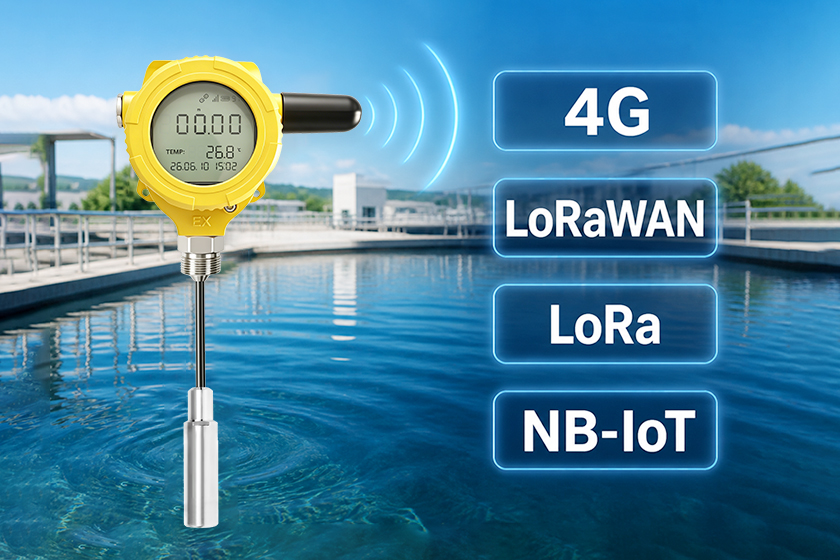
Solution 1: H2603 Wireless Water Level Sensor
The HOLYKELL H2603 Wireless Water Level Sensor is designed for remote liquid level monitoring applications. It combines hydrostatic level measurement with wireless communication technologies.
Typical applications include:
- Water tanks
- Wastewater monitoring
- Irrigation systems
- Oil and gas applications
- Fire water tanks
Key Features
- ✔ Wireless communication through 4G/LoRa/LoRaWAN/NB-IoT
- ✔ Measuring range from 0–1m to 50m
- ✔ Accuracy up to ±0.25%FS
- ✔ Low-power lithium battery design
- ✔ IP68 protection for harsh environments
- ✔ Remote monitoring through IoT platform
- ✔ Historical data storage
- ✔ Device status monitoring
Solution 2: Level Sensor + Wireless Gateway
For large projects with multiple measurement points, a sensor + gateway architecture is often more suitable.
Frequently Asked Questions
1. Which wireless technology is best for remote level monitoring?
There is no universal best technology. Choose the most suitable one.
2. What is the difference between LoRa and LoRaWAN?
LoRa is a wireless communication technology used for long-range data transmission.
LoRaWAN is a network protocol built on LoRa technology that manages communication between sensors, gateways, and servers.
3. Does a LoRa level sensor need a gateway?
Yes. A LoRa sensor normally communicates with a LoRa gateway, which forwards data to a cloud platform.
4. Does a 4G level sensor require a gateway?
No. A 4G wireless level sensor can directly connect to the cellular network and upload data to the cloud platform.
5. Which consumes less power, 4G or NB-IoT?
NB-IoT generally consumes less power because it is designed for low-data IoT applications.
It is commonly used for battery-powered remote monitoring devices.
6. Can one gateway connect multiple level sensors?
Yes. LoRaWAN gateway solutions are suitable for connecting multiple sensors in large monitoring networks.
7. What level sensor can be used for wireless monitoring?
Common options include submersible/radar/ultrasonic level sensors.
8. Can wireless level sensors send alarm notifications?
Yes. A remote level monitoring system can be configured to send alarms when level is too high or too low.
About the Author
Senior Engineer at HOLYKELL
Li Fei serves as a Senior Engineer at HOLYKELL, specializing in industrial sensing technologies and intelligent monitoring solutions.
With more than 15 years of experience in pressure measurement, level sensing, and Industrial IoT applications, he has participated in customized projects involving water management, wastewater treatment, oil and gas monitoring, agricultural irrigation, and industrial automation.
His expertise includes selecting suitable measurement technologies, designing wireless monitoring systems, and developing reliable sensing solutions for challenging environments.
Through practical engineering experience and continuous innovation, Li Fei helps customers improve operational efficiency, optimize asset management, and achieve smarter industrial monitoring.