
Holykell HPT604A vs WIKA LH-20: A Complete Comparison of Submersible Level Sensors
Introduction
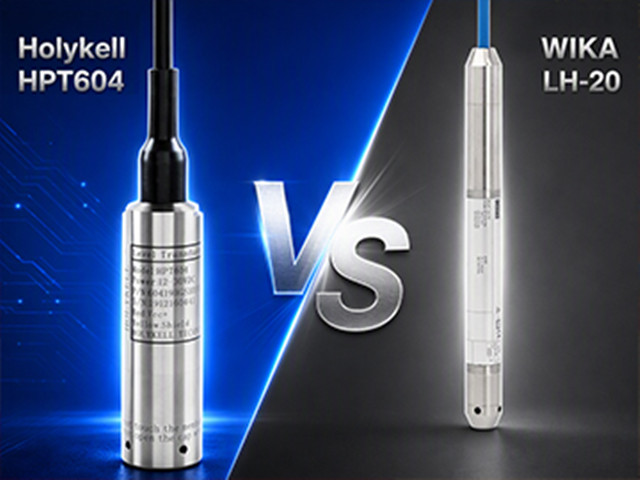
Engineers often compare WIKA LH-20 with Holykell HPT604A when selecting a submersible level transmitter because both are designed for hydrostatic liquid level measurement and support industrial applications such as groundwater monitoring, tanks, and process systems.
Both sensors use hydrostatic measurement technology, but they target different application requirements.
1. Product Overview
| Item | Holykell HPT604A | WIKA LH-20 |
|---|---|---|
| Product Type | Submersible Water Level Sensor | Submersible Pressure Transmitter |
| Main Applications | Water level measurement, groundwater monitoring, irrigation, tanks, wastewater | Deep wells, groundwater, hazardous areas, demanding industrial applications |
| Target Users | System integrators, OEM customers, industrial users | Large industrial projects, engineering companies |
| Positioning | Cost-effective industrial solution | Premium industrial solution |
Holykell HPT604 is designed for water level and depth measurement applications. It uses an imported piezoresistive sensing element and a 316L stainless steel sealed housing.
WIKA LH-20 is designed for demanding submerged level measurement tasks, including hazardous environments, with options such as titanium housing, HART communication, and high accuracy versions.
2. Technical Specification Comparison
| Specification | Holykell HPT604-A | WIKA LH-20 |
|---|---|---|
| Measuring Range | 0-500m (custom up to 1000m) | 0-250m |
| Accuracy | ±0.5% FS,±0.25% FS optional ±0.1%F.S by customized |
±0.2% standard, ±0.1% optional |
| Output Signal | 4-20mA / Hart / 0.5-4.5V / RS485 Modbus/0-10 V/SDI12… | 4-20mA / HART optional |
| Protection Rating | IP68 | IP68 |
| Wetted Material | 316L stainless steel, titanium alloy optional | 316L stainless steel, titanium optional |
| Operating Temp. | -40°C to +85°C | Up to +80°C depending on cable |
| Pressure Type | Gauge / Absolute optional | Relative / Absolute |
| Long-term Stability | ≤±0.1% FS/year | ≤0.1% FS/year |
| Probe diameter | 28mm | 22mm |
| Certificate | ATEX (II 1G Ex ia IIC T5 Ga), IECEx, RoHS and CE | ATEX(II 2G Ex ia IIC T6 Ga, Gb) |
3. Key Differences Between HPT604-A and LH-20
Measurement Range: HPT604-A Supports Deeper Measurement
The Holykell HPT604-A supports a wider measuring range:
- Standard range: up to 500 mH₂O
- Customized range: up to 1000 mH₂O
The WIKA LH-20 supports up to:
- 250 mH₂O
For deep wells, groundwater monitoring, and high-pressure liquid level measurement, a wider range provides more flexibility.
Accuracy: WIKA Focuses on Higher Precision
WIKA LH-20 provides:
- ±0.2% standard accuracy
- ±0.1% optional accuracy
Holykell HPT604-A provides:
- ±0.5% standard accuracy
- ±0.25% optional accuracy
- ±0.1% FS customized option
For applications requiring extremely high measurement precision, WIKA LH-20 provides higher standard accuracy. For most water level monitoring, tanks, irrigation, and industrial liquid measurement, ±0.5% FS accuracy is commonly sufficient.
Output Options: HPT604-A Provides More Communication Choices
| Output | HPT604-A | LH-20 |
|---|---|---|
| 4-20mA | ✔ | ✔ |
| HART | ✔ | Optional |
| RS485 Modbus | ✔ | — |
| 0-10V | ✔ | — |
| SDI-12 | ✔ | — |
HPT604-A supports multiple digital and analog interfaces, making it easier to integrate with:
- PLC systems
- RTU devices
- Data loggers
- Remote monitoring platforms
Environmental Performance
Both products provide:
- IP68 waterproof protection
- 316L stainless steel construction
- Titanium material options
The main difference:
| Item | Advantage |
|---|---|
| Temperature range | HPT604-A: -40°C to +85°C |
| Compact installation | LH-20: 22 mm probe diameter |
HPT604-A provides a wider operating temperature range, while LH-20 offers a more compact probe design.
Explosion-Proof Certification Comparison
| Certification | Holykell HPT604-A | WIKA LH-20 |
|---|---|---|
| ATEX | II 1G Ex ia IIC T5 Ga | II 2G Ex ia IIC T6 Ga, Gb |
| IECEx | ✔ | — |
| Protection Concept | Intrinsically safe | Intrinsically safe |
The certification levels are different:
- HPT604-A: II 1G → Equipment protection level for higher-risk Zone 0 gas environments.
- LH-20: II 2G → Equipment designed for Zone 1 gas environments.
The exact suitability depends on the customer’s hazardous area classification and project requirements.
4. Price & Value Comparison
| Item | Holykell HPT604-A | WIKA LH-20 |
|---|---|---|
| Approximate Price Level | Below USD 200 | Around USD 3,000+ |
| Main Value | Flexible configuration and cost-effective measurement solution | Premium brand, high accuracy, engineering project acceptance |
| Best Fit | OEM customers, distributors, general industrial applications | Large industrial projects, specification-driven applications |
5. Which One Should You Choose?
Choose Holykell HPT604-A If You Need:
- ✔ Wide measuring range up to 500m or customized 1000m
- ✔ Multiple communication options (RS485, SDI-12, HART, etc.)
- ✔ Reliable IP68 submersible measurement
- ✔ Competitive cost for multiple-unit projects
- ✔ Water, groundwater, irrigation, and industrial liquid monitoring
Choose WIKA LH-20 If You Need:
- ✔ Higher standard accuracy
- ✔ Compact 22mm probe design
- ✔ International premium brand recognition
- ✔ Project specifications requiring WIKA products
6. Summary
Both Holykell HPT604-A and WIKA LH-20 are professional submersible level transmitters designed for reliable hydrostatic level measurement.
The main differences are:
| Category | Difference |
|---|---|
| Accuracy | WIKA provides higher standard accuracy |
| Measurement Range | Holykell supports a wider range |
| Communication | Holykell offers more output options |
| Temperature Range | Holykell supports slightly higher temperature |
| Probe Size | WIKA has a smaller diameter |
| Certification | Both provide ATEX options, with different classifications |
| Price | Holykell provides a more cost-effective solution |
For users selecting a submersible level transmitter, the best choice depends on the required accuracy, certification, communication method, application environment, and project budget.
7. Frequently Asked Questions (FAQs)
Can a submersible level sensor replace a float switch for water level control?
Yes. A submersible level sensor can replace traditional float switches in many applications where continuous level monitoring is required. Unlike a float switch that only provides point-level signals (such as high or low level), a hydrostatic level sensor provides continuous liquid level data, allowing users to monitor trends, set alarms, and optimize pump control.
How long can a submersible level sensor work underwater?
A properly selected industrial submersible level sensor can typically operate for many years when installed correctly. Service life depends on factors such as liquid characteristics, cable material, sealing design, electrical protection, and maintenance conditions. For harsh environments such as wastewater, seawater, or chemical liquids, selecting suitable wetted materials and protection ratings is important.
Does cable length affect the accuracy of a submersible level sensor?
Cable length itself usually does not directly affect measurement accuracy. However, long cable installations may introduce issues such as signal interference, voltage drop, or incorrect cable selection. For deep wells, reservoirs, and remote monitoring systems, proper cable design, grounding, and signal type selection (such as RS485 or HART) help maintain reliable measurement.
What factors should be considered when selecting a submersible level sensor for a new project?
Engineers should consider more than measuring range and accuracy. Key factors include:
- Liquid type and chemical compatibility
- Installation depth and tank/well structure
- Required output signal and communication protocol
- Hazardous area certification requirements
- Operating temperature conditions
- Cable length and installation environment
- Maintenance and replacement requirements
A suitable sensor should match both the measurement requirements and the complete control system.
How do I choose between a submersible level sensor and a non-contact level sensor?
The choice depends on the application environment. Submersible level sensors directly measure hydrostatic pressure and are commonly used for deep wells, groundwater, tanks, and reservoirs. Non-contact technologies such as radar and ultrasonic sensors are suitable when contact with the liquid should be avoided, for example with corrosive, dirty, or aggressive media. The best choice depends on liquid conditions, installation limitations, and required measurement reliability.