
Overcoming Short Straight Pipe Challenge with Insertion Ultrasonic Flowmeter
Project Overview
A recent Singapore project involved sea water measurement in a DN600 carbon steel pipeline. The installation site presented a significant technical challenge: only 3.5 meters of straight pipe section was available, positioned between a T-junction on the left and multiple storage tanks on the right.
The Challenge: Turbulent Flow & Limited Space
Standard ultrasonic flowmeters typically require a straight run of 10D upstream and 5D downstream (i.e., 9 meters for a DN600 pipe) to ensure a stable flow profile.
In this application, the customer primarily chose a clamp-on type. While non-invasive, clamp-on sensors often fail in turbulent or high-velocity conditions when straight runs are insufficient. However, sea water monitoring requires high durability and consistent signal strength despite the harsh nature of the medium.
The HOLYKELL Solution: Parallel Insertion Technology
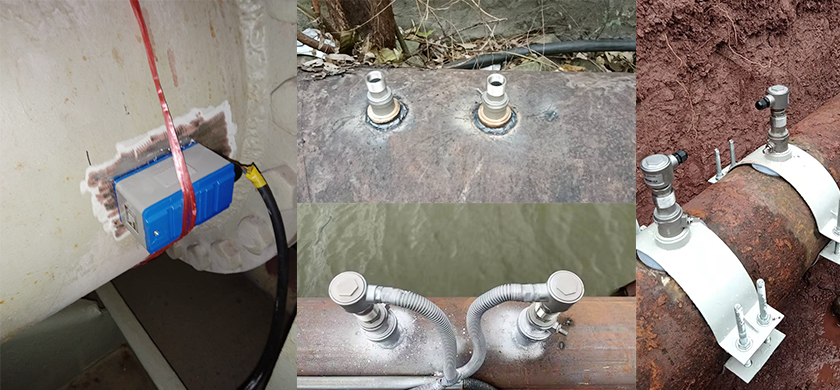
To bypass the limitations of straight pipe requirements, we implemented the Parallel Insertion Ultrasonic Flowmeter (Same-side installation).
- Adaptive Design for Complex Conditions
Unlike standard sensors, our parallel insertion sensors are customized based on the pipe diameter. For this DN600 application, the sensor length is optimized (typically 1/3 to 1/2 of the diameter) to ensure the probe reaches the core flow zone, drastically reducing the impact of turbulence.
Versatile Mounting: Supports top, side, or bottom installation depending on the fill level.
Low Fill-Level Solution: For pipelines that are not always full, we recommend bottom-entry parallel insertion to ensure the sensors remain submerged in at least 1/3 of the water height to maintain signal integrity.
- Superior Performance over Clamp-on Meters
Where clamp-on meters struggle with internal liners or heavy wall thickness, our insertion solution excels:
Liner Independent: Whether the pipe has cement, bitumen, or plastic lining, insertion sensors bypass the interface, eliminating signal attenuation.
Wall Thickness Versatility: Standard insertion probes handle walls up to 15mm. For thicker pipes, we provide Extended Insertion Probes to ensure the crystal reaches the fluid.
- Hot-Tapping & Ease of Installation
For clients concerned about downtime, our solution supports installation under pressure (Hot-Tapping). By using a dedicated ball valve and drilling tool, the system can be installed without shutting down the sea water supply.
Installation Tip: For DN600–DN700, standard probes are used; for DN1000 and above, extended probes are mandatory to find the optimal acoustic path.
Technical Specifications & Requirements
To ensure long-term accuracy in sea water applications, consider the following parameters:
Fluid Purity: Best suited for single-phase fluids with turbidity <10,000 ppm and particle size <1 mm.
Maintenance: Due to the nature of sea water, crystals may form on the probe over time. We recommend a monthly cleaning cycle—simply retract the sensor via the valve to prevent scaling from “locking” the probe in place.
Verification: Pipe material, operating temperature, and pressure must be confirmed before order to ensure the perfect seal and sensor calibration.
Why Choose Parallel Insertion?
Simpler Installation: Both sensors are installed on the same side of the pipe, reducing labor and alignment errors.
No Extra Fittings: If the pipe is weldable (like carbon steel), no additional pipe clamps are needed—simply weld the base and install.
Reliable Accuracy: Ideal for clients with limited installation experience or those dealing with “less-than-ideal” piping layouts.
Conclusion
The HOLYKELL Parallel Insertion Ultrasonic Flowmeter transforms a “difficult” site into a high-performance monitoring point. By moving the measurement point inside the pipe, we eliminate the variables that cause external sensors to fail.
Contact our engineering team today to customize a flow solution for your specific pipeline diameter and environment.