
ATEX vs IECEx: What’s the Difference?
TL;DR
ATEX and IECEx are both explosion protection certification systems based on similar IEC 60079 standards, but they serve different markets. ATEX is legally required for equipment sold in the European Union, while IECEx is an internationally recognized certification system widely accepted outside the EU. For global industrial projects, many buyers prefer equipment certified to both ATEX and IECEx.
If you’re sourcing explosion-proof pressure sensors, level transmitters, or other hazardous-area instrumentation, you’ve probably encountered both ATEX and IECEx certifications.
Although they often appear together on product datasheets, they are not interchangeable. Understanding the difference helps buyers avoid compliance issues, reduce project risks, and select equipment suitable for international markets.
This guide explains the key differences, similarities, and when you should choose one—or both.
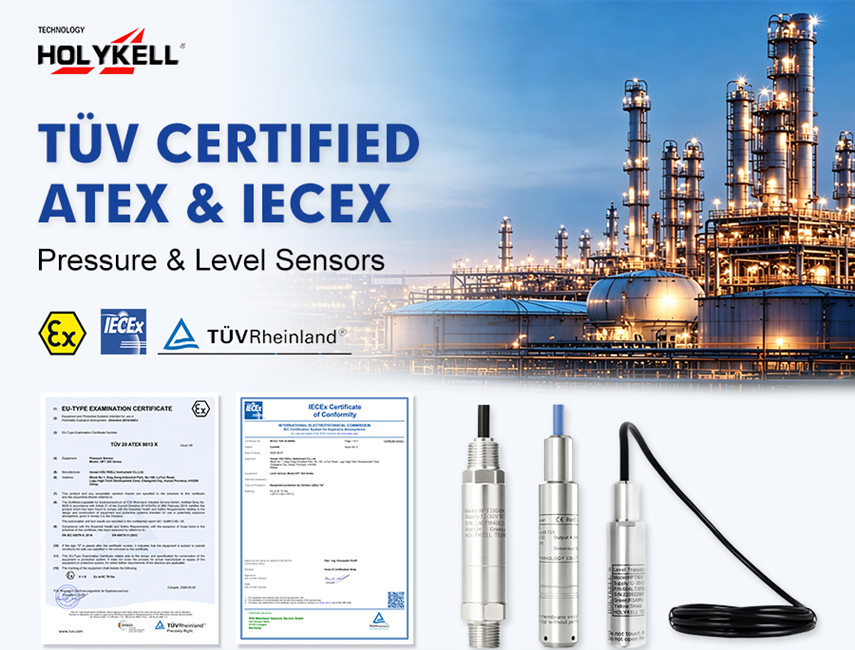
Key Differences Between ATEX and IECEx
Although both certification systems aim to ensure equipment can operate safely in explosive atmospheres, they differ in legal scope, application, and certification process.
ATEX
- Mandatory for equipment sold within the European Union
- Based on the ATEX Directive 2014/34/EU
- Requires CE marking alongside the Ex marking
- Assessment performed by an EU Notified Body for applicable equipment categories
- Covers both equipment manufacturers and workplace requirements
IECEx
- International certification system managed by the IEC
- Used in many countries outside Europe
- Based entirely on the IEC 60079 standards
- Does not require CE marking
- Provides globally recognized test reports and certificates
Similarities
Both systems:
- Focus on preventing ignition in hazardous areas
- Use similar explosion protection concepts
- Classify hazardous locations into Zones
- Apply the IEC 60079 series of technical standards
- Require product testing and manufacturing quality assessment
ATEX vs IECEx Comparison
| Feature | ATEX | IECEx |
|---|---|---|
| Primary Purpose | EU legal compliance | International certification |
| Geographic Scope | European Union | Global |
| Mandatory | Yes (EU) | Usually voluntary, depending on country |
| Based on IEC 60079 | Yes | Yes |
| CE Mark Required | Yes | No |
| Certificate Issued By | EU Notified Body | IECEx Certification Body |
| Typical Application | Equipment sold in Europe | International export projects |
| Best Choice | EU-only projects | Global projects |
| Recommended for Exporters | Dual ATEX + IECEx Certification | |
Why the Certification Body Matters
For industrial buyers, who issues the certificate can be just as important as the certificate itself.
Large EPC contractors, engineering companies, and multinational manufacturers often prefer certificates issued by internationally recognized organizations because they simplify project approvals and customer audits.
| Comparison | TÜV SÜD | ECM |
|---|---|---|
| EU Notified Body | Yes (CE 0123) | Yes |
| Global Brand Recognition | Excellent | Limited |
| Widely Accepted by EPC Contractors | Yes | Varies by project |
| Industrial Reputation | High | Moderate |
| Preferred for Oil & Gas, Chemical & Energy Projects | Yes | Project dependent |
For projects involving hazardous environments, choosing products certified by a highly recognized Notified Body can reduce documentation reviews and improve buyer confidence.
Typical Certification Parameters
The following table shows typical explosion protection information found on certified pressure sensors.
| Parameter | ATEX | IECEx |
|---|---|---|
| Example Certificate | ATEX Certificate | IECEx Certificate |
| Typical Marking | Ex II 1G Ex ia IIC T4 Ga | Ex ia IIC T4 Ga |
| Equipment Group | II | II |
| Protection Method | Ex ia (Intrinsic Safety) | Ex ia |
| Gas Group | IIC | IIC |
| Temperature Class | T4 | T4 |
| Equipment Protection Level | Ga | Ga |
| Hazardous Area | Zone 0 / 1 / 2 | Zone 0 / 1 / 2 |
| Main Standard | EN IEC 60079 Series | IEC 60079 Series |
Always verify that the certification marking matches your site’s hazardous area classification before selecting equipment.
Real User Scenario
Chemical Storage Project Serving Multiple Countries
An EPC contractor is building chemical storage systems for customers in France, Malaysia, and Australia.
If only ATEX-certified pressure sensors are purchased:
- They fully satisfy EU legal requirements.
- Additional certification verification may be needed for projects outside Europe.
If only IECEx-certified products are selected:
- They may be accepted in many international markets.
- They cannot replace ATEX certification for products placed on the EU market.
Instead, the contractor selects pressure transmitters carrying both ATEX and IECEx certificates.
This approach offers several advantages:
- One product specification for all projects
- Simplified procurement
- Easier spare parts management
- Reduced engineering documentation
- Greater flexibility for future export markets
Many wastewater treatment plants, pharmaceutical facilities, hydrogen projects, and oil & gas installations follow the same procurement strategy.
FAQ
1. Is ATEX the same as IECEx?
No. They are based on many of the same technical standards but are different certification systems. ATEX is an EU legal requirement, while IECEx is an international certification scheme.
2. Which certification should I choose?
If your equipment will only be used in the European Union, ATEX is required. If your business exports globally or serves multinational customers, dual ATEX and IECEx certification is often the most practical option.
3. Can one product have both ATEX and IECEx certification?
Yes. Many industrial manufacturers certify the same product under both systems. By coordinating the testing process, it is possible to obtain both certifications through a single certification program, helping reduce certification costs by up to 40% and project timelines by up to 50% compared with managing two separate certification processes.
Choosing a Certified Pressure Sensor
When comparing explosion-proof pressure sensors, buyers should evaluate more than just the presence of a certificate.
Consider:
- Is the product certified for both ATEX and IECEx?
- Which organization issued the certificate?
- Does the Ex marking match your hazardous area classification?
- Is the manufacturer able to provide complete certification documentation?
- Does the certification support your current and future export markets?
For many international projects, equipment carrying dual certification from a recognized certification body provides greater flexibility throughout the product lifecycle.
Conclusion
ATEX and IECEx are closely related but serve different purposes. ATEX ensures legal compliance within the European Union, while IECEx supports international acceptance across many global markets.
If your projects involve multiple countries, selecting pressure sensors with both ATEX and IECEx certification can simplify procurement, reduce compliance risks, and avoid maintaining separate product versions.
Products that are dual-certified by TÜV offer the additional confidence of certification from one of the world’s most recognized Notified Bodies. Through a coordinated certification process, manufacturers can complete one test program to obtain both certificates, reducing certification costs by approximately 40% and shortening certification time by up to 50%.
Need help evaluating explosion-proof certifications? Contact us to receive the step-by-step implementation guide and best practices checklist.