
How to Evaluate a Chinese Level Sensor Manufacturer? A Complete Buyer’s Guide
Choosing a level sensor manufacturer in China can provide significant advantages, including competitive pricing, flexible customization, and fast production capability. However, not every supplier has the same technical capability.
Some companies are professional manufacturers with their own R&D teams, production lines, calibration equipment, and quality systems. Others may only act as trading companies or resellers.
For industrial applications, selecting the right supplier is not only about price. A reliable manufacturer should be able to provide:
- Stable product quality
- Accurate measurement performance
- Required certifications
- Technical support
- Long-term supply capability
This guide explains the key factors to evaluate before selecting a Chinese level sensor manufacturer.
Quick Checklist: How to Evaluate a Level Sensor Manufacturer
Before making a decision, check these key areas:
| Evaluation Factor | What to Check |
|---|---|
| Manufacturing Capability | Factory, production lines, R&D team |
| Product Quality | Testing equipment, calibration process |
| Certifications | ISO, CE, ATEX, IECEx, other approvals |
| Technical Experience | Industry applications and engineering support |
| Customization Ability | OEM/ODM, special requirements |
| Customer Support | Response time, after-sales service |
1. Verify Whether It Is a Real Manufacturer
The first step is confirming whether the company actually manufactures level sensors.
A genuine manufacturer usually has:
- Its own production facility
- Engineering and R&D team
- Product testing equipment
- Quality control procedures
- Manufacturing experience
A trading company may only provide product catalogs but cannot control:
- Production quality
- Delivery schedule
- Product customization
- Technical troubleshooting
What to Check:
| Item | Questions to Ask |
|---|---|
| Factory | Can you provide factory photos or video audit? |
| Production | Do you have your own assembly and testing lines? |
| Engineering | Do you have engineers supporting product selection? |
| Experience | How many years have you manufactured level sensors? |
2. Check Product Certifications and Compliance
Certifications are important because they show whether products meet specific market and application requirements. However, buyers should check whether the certificate matches:
- The actual product model
- The manufacturing company
- The application requirement
Common certifications for industrial level sensors include:
| Certification | Application |
|---|---|
| ISO 9001 | Quality management system |
| CE | European market compliance |
| ATEX | Explosion-proof applications in Europe |
| IECEx | International hazardous area certification |
| RoHS / REACH | Environmental compliance |
For example:
A level sensor used in an oil refinery may require ATEX or IECEx certification, while a water tank application may only require general industrial compliance.
A professional supplier should provide complete certification documents instead of only showing certificate logos.
3. Evaluate Technical Capability and Product Range
A reliable level sensor manufacturer should understand different measurement technologies and application requirements.
Common level measurement technologies include:
| Technology | Suitable Applications | Advantages |
|---|---|---|
| Hydrostatic | Water tanks, wells, reservoirs | Reliable for liquid level measurement |
| Radar | Chemical tanks, storage tanks | Non-contact measurement |
| Ultrasonic | Water treatment, open tanks | Easy installation |
| Capacitive | Fuel tanks, small tanks | Compact design |
| Wireless | Remote monitoring applications | No wiring required |
A strong manufacturer should not only sell products but also help customers select the correct technology based on:
- Medium characteristics
- Temperature
- Pressure
- Tank structure
- Installation environment
4. Check Testing and Quality Control Process
For measurement instruments, product consistency is critical. A professional manufacturer should have testing procedures covering:
| Quality Control Stage | What Is Checked | Why It Matters |
|---|---|---|
| Incoming Inspection |
|
Ensures that all materials meet quality requirements before production. |
| Production Testing |
|
Verifies product performance, assembly quality, and communication reliability. |
| Calibration Testing |
|
Ensures the sensor provides reliable and consistent measurement results before shipment. |
Questions to Ask a Level Sensor Manufacturer
| Question | Why It Matters |
|---|---|
| Is every sensor calibrated before shipment? | Confirms whether each product has passed accuracy verification. |
| Can you provide calibration reports? | Shows measurement traceability and quality control capability. |
| How are production records tracked? | Helps verify manufacturing consistency and after-sales support. |
5. Evaluate Customization Capability
Industrial projects often require customized solutions. A capable manufacturer should support:
| Requirement | Example |
|---|---|
| Output Signal | 4-20mA, RS485, HART |
| Communication | Modbus, MQTT, LoRa, NB-IoT |
| Structure | Different probes or connections |
| Materials | Stainless steel, special coatings |
| Certification | Explosion-proof versions |
Customization capability is especially important for OEM customers, system integrators and engineering companies.
6. Review Industry Experience and Applications
A datasheet only shows product specifications. Real application experience shows whether the manufacturer understands practical challenges.
Ask:
- Has the sensor been used in similar industries?
- Are there reference projects?
- Can engineers provide application recommendations?
Typical level sensor applications include:
| Industry | Applications |
|---|---|
| Water Treatment | Tanks, reservoirs, wastewater |
| Oil & Gas | Fuel tanks, chemical storage |
| Agriculture | Irrigation monitoring |
| Mining | Remote water monitoring |
| Manufacturing | Process tanks |
7. Evaluate Communication and Technical Support
Technical communication is often overlooked but directly affects project success.
A reliable supplier should provide:
- Fast response to technical questions
- Clear datasheets
- Installation guidance
- Wiring instructions
- Troubleshooting support
8. Factory Audit Before Large Orders
For large projects or long-term cooperation, a factory audit is recommended.
You can check:
| Area | Items to Check |
|---|---|
| Production Area |
|
| Quality System |
|
| Engineering Capability |
|
A factory audit helps buyers understand whether the supplier can consistently deliver products, not just provide samples.
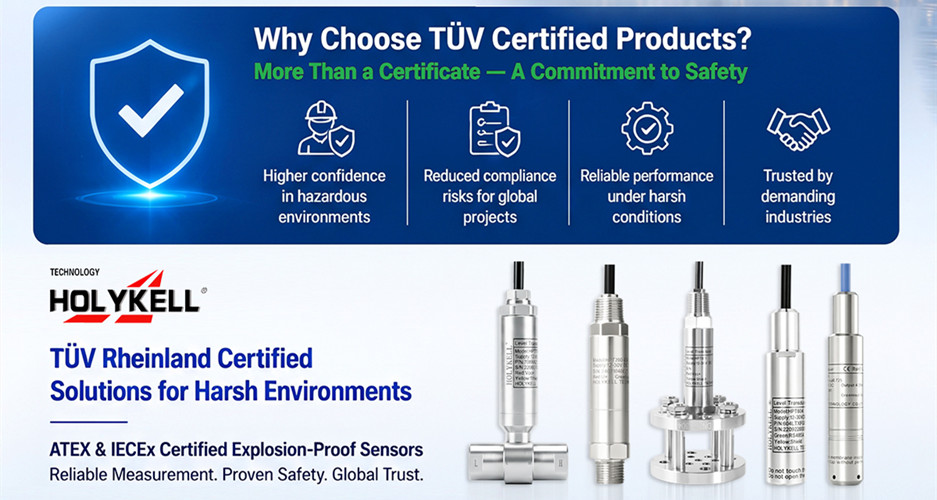
HOLYKELL — A Level Sensor Manufacturer Founded in 2001
HOLYKELL, founded in 2001, is a China level sensor manufacturer and offers various level technologies.
- More than 20 years of sensor manufacturing experience
- Professional R&D and production teams
- ISO 9001 quality management system
- ATEX & IECEx certification issued by TUV
- Multiple communication options and wireless solutions
- Customized solutions for industrial applications
FAQ
How do I know if a Chinese level sensor supplier is a manufacturer?
Check whether the company has its own factory, production equipment, engineering team, and quality control process. Request factory photos, videos, or an online factory audit.
What certifications should I ask for when buying level sensors from China?
It depends on the application. Common certifications include ISO 9001, CE, RoHS, and ATEX/IECEx for hazardous environments.
Should I choose a cheaper level sensor supplier?
Price is only one factor. A lower price may result from reduced testing, lower-quality components, or limited technical support. Evaluate the total cost including reliability and after-sales service.
Can Chinese level sensor manufacturers provide OEM solutions?
Yes. Many professional manufacturers provide OEM customization, including mechanical design, communication protocols, labels, packaging, and software integration.
Conclusion
Choosing a Chinese level sensor manufacturer requires more than comparing product prices.
By evaluating these factors, buyers can reduce supply risks and build a reliable partnership with the right sensor manufacturer.
About Author
Li Fei is a Senior Engineer at HOLYKELL, specializing in industrial sensing solutions including level measurement, pressure monitoring, and IoT-based sensor applications.
With years of experience supporting global customers in water, energy, and industrial automation industries, Li Fei shares practical knowledge about sensor selection and application solutions.