
What Is a Radar Flow Meter and How Does It Work? A Complete Guide
Traditional flow measurement methods often require direct contact with water, installation of structures, or regular maintenance.
However, many real-world applications, such as rivers, open channels, flood monitoring systems, and sewage networks, face challenges including dirty water and sediment, corrosive liquids, difficult installation environments, flood risks, high maintenance costs.
To solve these challenges, radar flow meters have become an advanced solution based on non-contact radar technology.
A radar flow meter can measure water level, surface velocity, and flow rate without contacting the water, making it especially suitable for open channel flow measurement and water resource monitoring.
1. What Is a Radar Flow Meter?
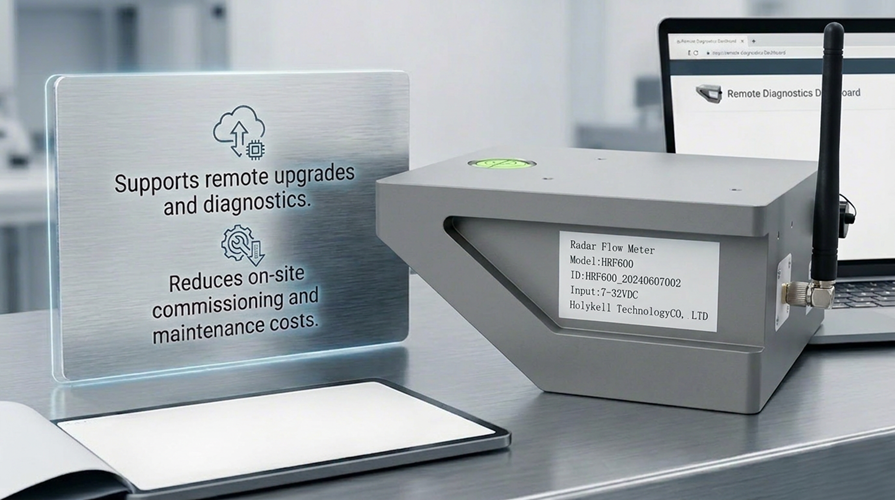
A radar flow meter is a non-contact flow measurement instrument that uses microwave radar technology to measure the velocity and level of flowing water, then calculates the flow rate.
Unlike traditional flow meters that require sensors to be installed inside the water, radar flow meters are installed above the water surface.
The basic measurement process includes:
- Measuring water surface velocity
- Measuring water level
- Calculating cross-sectional area
- Combining velocity and area to calculate flow rate
The radar flowmeter integrates water level measurement, velocity measurement, and flow calculation functions, and can output instantaneous flow and cumulative flow data.
2. How Does a Radar Flow Meter Work?
A radar flow meter usually combines two radar technologies:
2.1 Doppler Radar for Flow Velocity Measurement
The radar sensor sends microwave signals toward the moving water surface. When the microwave encounters moving objects such as:
- Water waves
- Floating particles
- Bubbles
the reflected signal frequency changes.
This frequency difference is called the Doppler shift.
By analyzing this frequency change, the radar sensor calculates the surface velocity of the water.
2.2 FMCW Radar for Water Level Measurement
For water level measurement, radar flow meters commonly use FMCW (Frequency Modulated Continuous Wave) technology. The radar emits electromagnetic waves toward the water surface. The signal is reflected back to the sensor. The difference between transmitted and received frequencies is analyzed to calculate the distance between the sensor and water surface.
3. How Does a Radar Flow Meter Calculate Flow Rate?
After obtaining water surface velocity, water level, the system calculates the flow rate using the flow-area method.
The calculation principle is:
Flow Rate = Average Velocity × Cross-sectional Area × Correction Coefficient
The radar flow meter first calculates the water cross-sectional area based on measured water level, then converts surface velocity into average velocity through hydraulic algorithms.
The radar flowmeter calculates flow based on measured velocity, water level, channel parameters, and hydraulic model algorithms for different channel shapes such as rectangular, trapezoidal, and circular channels.
4. Advantages of Radar Flow Meter Technology
4.1 Non-Contact Measurement
The biggest advantage of radar flow meters is that the sensor does not touch the water.
Benefits:
- No sensor corrosion
- No sediment blockage
- Less maintenance
- Safer installation
Unlike submerged sensors, radar flow meters are not affected by water quality problems such as sewage contamination or sediment accumulation.
4.2 Easy Installation Without Changing Hydraulic Conditions
Traditional flow measurement may require weirs, flumes, pipe modification, civil construction. Radar flow meters can measure flow above the water surface without changing channel structures.
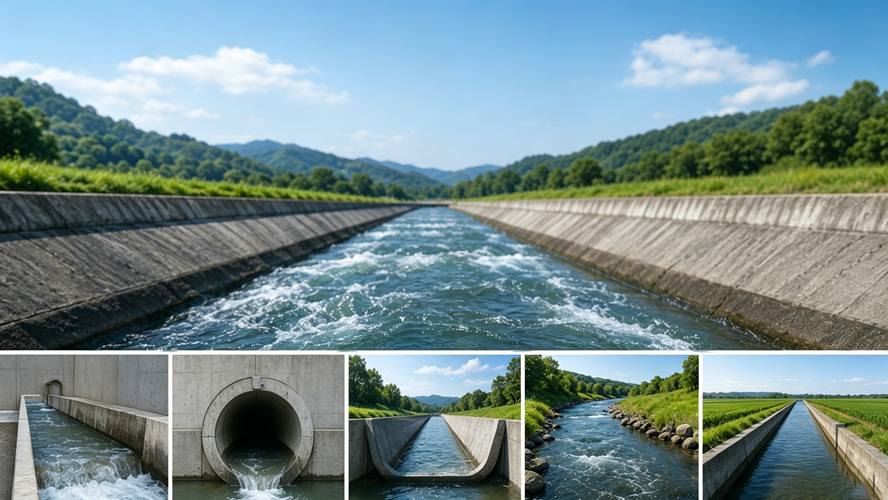
This makes them suitable for rivers, open channels, irrigation channels, flood monitoring, providing non-contact measurement in rivers, open channels, irrigation channels, underground drainage networks, and flood control applications.
4.3 Stable Measurement in Harsh Environments
Radar technology performs well in outdoor environments. Advantages include:
- Rain mode interference suppression
- Wide temperature operation
- IP68 protection
- Low power consumption
It supports rainy-day measurement modes and has IP68 waterproof protection.
5. Radar Flow Meter Accuracy
Measurement accuracy depends on:
- Radar frequency
- Installation condition
- Channel shape
- Flow characteristics
- Parameter settings
6. Where Are Radar Flow Meters Used?
6.1 River Flow Monitoring
Applications:
- Hydrological stations
- Flood warning systems
- Water resource monitoring
6.2 Open Channel Flow Measurement
Used for:
- Irrigation channels
- Agricultural water management
- Industrial drainage channels
6.3 Sewage and Wastewater Monitoring
Advantages:
- No contact with polluted water
- Resistant to sediment
- Low maintenance
6.4 Reservoir and Flood Control
Radar flow meters help monitor:
- Water level changes
- Flow velocity
- Flood risks
7. Radar Flow Meter vs Traditional Flow Meter
| Feature | Radar Flow Meter | Traditional Flow Meter |
|---|---|---|
| Measurement Method | Non-contact | Usually contact |
| Installation | Above water | Requires installation inside pipe/channel |
| Maintenance | Low | Higher |
| Sediment Impact | Minimal | Possible influence |
| Corrosion Risk | Very low | Higher |
| Suitable for Open Channels | Excellent | Limited |
8. How to Choose a Radar Flow Meter?
Before selecting a radar flow meter, consider:
1. Application Type
Is it:
- River?
- Open channel?
- Sewage channel?
- Flood monitoring?
2. Flow Range
Confirm:
- Minimum velocity
- Maximum velocity
- Water level range
3. Installation Environment
Check:
- Installation height
- Channel width
- Water surface conditions
4. Communication Requirements
Common outputs:
- RS485 Modbus
- RS232
- 4-20mA
- LoRa
- 4G
9. Frequently Asked Questions
Q1: Is a radar flow meter suitable for low flow velocity measurement?
A: Radar flow meters can measure low water velocities, but the measurement performance depends on the application conditions, radar technology, and installation environment. A stable water surface with sufficient radar reflection is important for reliable measurement, especially in slow-flowing channels.
Q2: Does a radar flow meter require water surface movement to measure flow?
A: Yes. Radar flow meters measure flow velocity based on the movement of the water surface. Natural surface waves, small ripples, or floating particles can provide reflection signals for velocity calculation. Extremely calm water surfaces may require additional evaluation before installation.
Q3: Can one radar flow meter be used for different types of channels?
A: Radar flow meters can be applied to various channel types, including rectangular channels, trapezoidal channels, rivers, and drainage channels. However, channel dimensions and hydraulic conditions need to be configured correctly to ensure accurate flow calculation.
Q4: How high can a radar flow meter be installed above the water surface?
A: The installation height depends on the radar measurement range, antenna characteristics, and site conditions. Before installation, users should confirm the distance between the sensor and water surface, channel width, and required measurement range to select the appropriate model.
Q5: Does a radar flow meter need regular calibration?
A: Radar flow meters generally require less maintenance compared with contact-type flow measurement devices.
Q6: Can radar flow meters replace ultrasonic flow meters?
A: Radar and ultrasonic flow meters use different measurement technologies and are suitable for different application conditions.
Conclusion
Radar flow meters are becoming increasingly important in water management, hydrology, wastewater monitoring, and smart water systems.
For engineers, system integrators, and water management professionals, radar flow measurement provides a safer, more reliable, and cost-effective way to monitor water flow.
Contact us for more.